Personal Network Braindump
We strive for a human-centric, personal network with interactions between humans. No consistent view of things required, and no central server.
Your personal data should be strongly attached to a service and easy to move between server.
It should be fun to hack and tinker with the network. If you want to write The Capybara Network, you only need to fill out some logic code, then everyone in the network should be able to use your library to integrate into their pods.
Periphery
The periphery server fulfills three functions. It executes pods, ensures that identity of people and capabilities are distributed through the network and forwards messages from outboxes to other periphery inboxes.
The communication between periphery server happen unencrypted. Either the messages are signed by the person (for example issuing a keypair on behalf of someone) or message payloads are already encrypted with publicly available keys.
The periphery server has a friends server list, to which we
publish changes in provided capabilities. If the current
server hosts no pod of an identity, only the hey pod is
referenced.
Furthermore, it allows easy migration of pods between server, such that no interruption is in the processing of incoming messages found.
Move to identity note:
The main communication tool centers around protocols defined by pairs of identifiers and capabilities. Every identity of a person is unique, same as every capability is unique.
To distinguish several pods offering the same capabilities (for example git social features), we also introduce a third element which is the associated name. This triple has to be unique.
relation to microkernel In function the approach can be compared to microkernels, where the periphery (there supervisor) executes several servers in user-mode and ensures the communication between them.
Identity and Behalfs
Every person in the network is strongly identified by their public key fingerprint. It also acts as a token for discovering capabilities a person supports. (for example leaving a message)
The setup mostly follows GnuPG. We store a keypair on the personal computer and issue certificates for pods distributed in the periphery. The personal public key is distributed to all servers, together with the signatures of the tuple (pod endpoint, public key).
When moving the pod to a different server, the keypair has to be renewed with the new server endpoint signed. We also advise adding a expiry time.
Of Boxes
Pods internal logic orchestrate communication flow between people and can issue one-to-many communication (for example listing all Git pods of a person), multi-hop dependencies (getting participants of a Git issue, then their mail addresses) and long-running multi-response messages (subscription or paging of long messages).
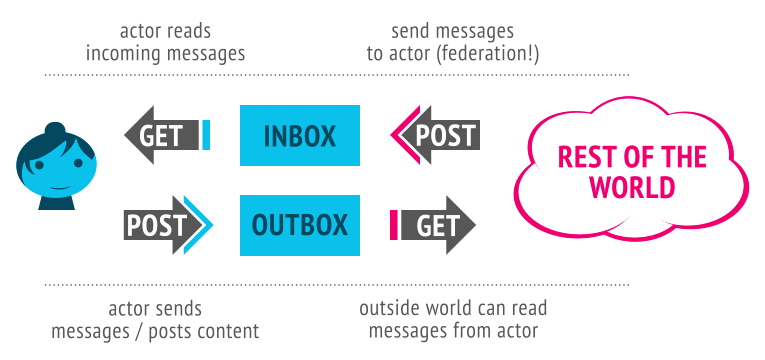
The periphery abstracts the task of transporting messages from home to recipients server. Similar to the ActivityPub protocol, this happens with concepts of boxes. Every pod has a pair of inbox and outbox. The periphery distributes incoming messages to matching inboxes and forwards messages lying in outboxes to the matching server.
lifecycle of communication Putting a message into the outbox has the following signature
(Vec
, Capability, Payload) -> ResponseToken.
The periphery normalizes the list of recipients and matches the capability fingerprint with available servers. It then encrypts the message with public keys of all recipients. It also appends the response token for the other periphery server to use in their response.
The receiving server matches the message, puts it into the inbox of the corresponding pod which then processes the message and generates one (or many) responses with the response token attached. The other server then forwards messages again to the home server in the same way.
Necessity of async execution within pods
Some routines can be modeled with sync execution only, such as asking for CLI commands, setting up virtual file system with FUSE. Others, on the other hand, benefit immensely from being able to write execution logic in asynchronous way. A prominent example are TUIs fetching and displaying data from external sources.
The WASM model currently allows declaring functions as async in wasmtime, which processes all functional calls as non-blocking. On the other hand, wstd brings a full async executor into the WASM application, which supports the WASIp2 standard.
To communicate with other pods, messages are put into mailboxes of the federation server and forwarded to individual pods, which are then answering their calls.
To schedule correct order of execution with dependencies spanning multiple pods, asnychronous execution is essential. For example, to get a photo made with a friends, we can imagine the following dependencies:
fetch friends -> filter by name -> get photo at friend’s pod
Capability Fingerprint
The system organizes around capabilities, describing abilities of a connected identifier. They are unique and strongly attached to the supporting API.
When posting a message into the outbox of the periphery, the message contains a recipients field together with the capability fingerprint. (and maybe a name to distinguish multiple instances)
The periphery resolves the server of recipients and negotiate the proper calling convention with their server. Once, both match (user and protocol) the message is forwarded to the inbox of all recipients.
This makes interfaces immutable and only appendable with new sets of interfaces, which may supersede old ones.
Pods with proper subsets of protocols may still use those partials to communicate with supersets. But missing functionality cannot be replaced for and should return an missing implementation error.
Abstracting Capabilities Away
Pods are human-centric. A developer should just be able to write a list of supported functions and the library should fill in all the remaining bits.
This includes
- generating functions the sender side can use to create a message and wait for the response
- creating a structure for arguments and response, which is serializable
- generate a unique capability fingerprint, representing the API
Rust proc-macro system is capable of all. We can sketch the following:
struct GitRepo {
    issues: Vec<Issue>,
    prs: Vec<PR>,
}

#[capability]
impl GitRepo {
    fn add_issue(&mut self, sender: Person, issue: Issue) -> Future<()> {
        // check sender has the access rights for adding an issue
        // this may call to the home server
        self.check_access(&sender).await?;
        self.issues.push(issue);

        Ok(())
    }
}
What are examples of crates doing this?
Human Interacting with Pods
For now, we have only described how pods are defined and how they interact with each other. To also have human interactions, pods need to define human interfaces.
For simplicity, we initially only support text interfaces and everything-is-a-file paradigm. Both are communicated with the SSH protocol to reduce periphery complexity.
From the pod perspective, we define a function when someone logs into SSH and render a TUI with given stdout/stdin. For file support via SFTP, we have open/read/write/readdir to render a view of the current pod state into a virtual filesystem.
At the user side we can connect via ssh or sshfs to both and can identify with a special token signed with the person private key. The periphery hosts the actual SSH server and multiplexes calls to the individual pods.
Imaginable ways to render views
The following ways are possible for rendering the content of a pod for different consumption
- offer editable file system via FUSE
- add a WASI interface to register a set of files
- present the content of a pod formated via files
- trigger mutation events when files are saved
- SSH server for TUI interface
- connect to builtin TUI interface via SSH client
- provide modal interface to modify and view content
- take inspiration from https://github.com/Eugeny/russh/blob/main/russh/examples/ratatui_app.rs
- create WASI interface which binds an SSH server to a port and provides a write/read methods which are called upon changes
- CLI interface from supervisor
- use allow-external from clap https://docs.rs/clap/latest/clap/struct.Command.html#method.allow_external_subcommands to dispatch commands to pods
Dealing with files and streams
Boxes are for messaging only. To transmit larger files (for examples images) or have streaming support (one could imagine audio chats), we support a special direct communication approach.
The periphery supports a stateful bidirectional connection with token identifier. The tokens form a flat hierarchy without any hash, names or groups, and can be used to read from and write to.
Ideas for Pods
Some random ideas what patterns could fit into pods
-
Hey Pod Represent trusted people fingerprints
Build a web of trusted people by signing their public keys. Add small messages to their personal spaces, similar to friend books.
-
Git Pod Augment Git with additional social features
Bundle Git repository with pod WASM file and offer capabilities for submitting patches, creating issues and hosting small wikis
-
Book Sharing Pod Comment books and share them
Ask for books and send them to your friends via DHL Packstation
-
Language Pod
-
Podcast Pod
Examples of other federated protocols
Scuttlebutt is a service for hosting distributed social networks and ensuring that content disseminate untampered through the network.
AT Protocol supports the Bluesky service and allows separation of user data from indexing.
ActivityPub is the default model for many federated service with the largest provider, Mastodon.
Aether provides many-to-many communication in a distributed manner.
Minimal viable product
A minimal useable prototype of a pod system contains the following abilities:
- storing some state which can be restored after a session
- allowing interaction with CLI
- some editing with files
Build web-of-trust with OpenPGP and simple leave a message for a friend function.
What we do not want to do
Create a blockchain-like structure with immutable, append-only, data using something like a Merkle tree.